NAIL Lab
Networked Autonomous and Intelligent Learning Lab
University of Houston
The NAIL Lab advances safe, intelligent, and collaborative autonomous systems that operate reliably in dynamic, uncertain, and resource-constrained environments. Bridging machine learning, control theory, robotics, and embedded AI, we design learning-based controllers and planners with formal safety guarantees, help people and teams of robots and vehicles work together through trust-aware task allocation and distributed control, bring reliable onboard planning to spacecraft and planetary robots, and build efficient perception models that run in real time on embedded hardware. We validate our methods on drones, ground robots, quadrupeds, and microcontrollers.
-
 Direction 1 Safe Learning & Trustworthy Autonomy
 -
 Direction 2 Human–AI Collaboration & Multi-Agent Autonomy
 -
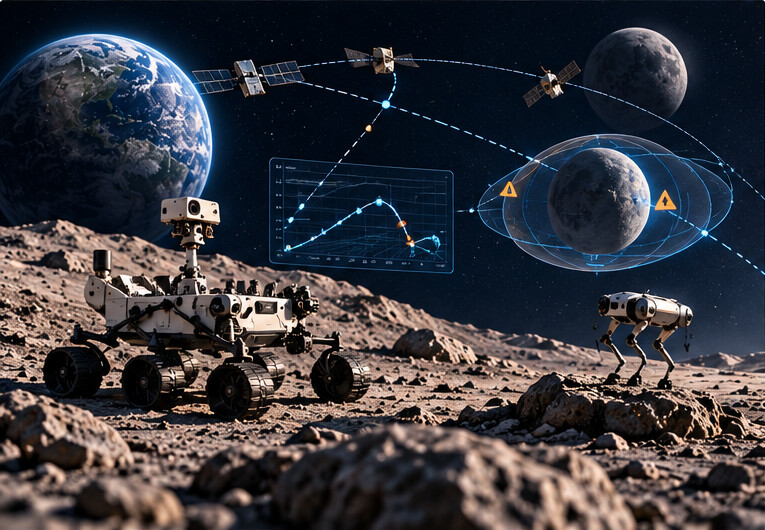 Direction 3 Space & Planetary Autonomy
 -
 Direction 4 Efficient Edge AI & Intelligent Perception
Supported by




Recent research
All videos on YouTube- CoRL 2026
CERT-Replan: risk-certified replanning for dynamic navigation
Replans when moving obstacles make the current plan too risky. Cuts collisions by 83.3% and safety-filter interventions by 32.4% versus a safety-filter-only baseline.
- IROS-LBS 2026
3D leader-follower flight with camera safety
Keeps the leader in each follower drone's camera view using onboard perception only. Cuts formation-tracking error by 36.7–54.2% versus IBVS and holds visibility where an unfiltered controller loses the leader.
- IROS 2026
Formation-aware conformal perception
Adapts perception uncertainty bounds to each robot's position in the camera view, keeping vision-based formations safe without excess caution. Reaches 95% success over 100 trials, versus 73% for the best fixed-bound baseline.
- ICRA-LBS 2025
LLM-guided drone navigation and object detection
Turns a natural-language command into a multi-step drone mission. A 1B-parameter Llama model, LoRA-tuned on 4,500 prompts (about 3.5% of its weights), plans the flight while onboard detection runs at up to about 25 FPS.
- IEEE TC 2026
ELASTIC: object detection on microcontrollers
Finds object detectors small enough for tiny microcontrollers. Versus Analog Devices' TinySSD, it uses up to 71.6% less energy, runs up to 2.4× faster, and adds up to 6.99 points of mAP.
- ICRA 2025
Perception-aware safe leader-follower control
Treats each follower camera's limited field of view as a safety constraint, so robots keep their leader in sight. In simulation it holds formations where the baseline controller fails.
News
All news- Congratulations to Richie Suganda on receiving three competitive travel awards: the CoRL 2026 Travel Award, the IROS 2026 Student and Developing Countries (SDC) Travel Award, and the UH Cullen Fellowship Travel Grant. The CoRL and IROS awards support his presentations of our papers Adaptive Risk-Certified Event-Triggered Replanning for Dynamic Navigation at CoRL 2026 and Formation-Aware Adaptive Conformalized Perception for Safe Leader-Follower Multi-Robot Systems at IROS 2026.
- Our paper Adaptive Risk-Certified Event-Triggered Replanning for Dynamic Navigation has been accepted for presentation at the 2026 Conference on Robot Learning (CoRL 2026), November 9–12, 2026, Austin, TX, USA. (Acceptance Rate: 32.8%) [Project Page].
- Our paper Formation-Aware Adaptive Conformalized Perception for Safe Leader-Follower Multi-Robot Systems has been accepted for presentation at the 2026 IEEE/RSJ International Conference on Intelligent Robots and Systems (IROS 2026), September 27 – October 1, 2026, Pittsburgh, PA, USA. (Acceptance Rate: 36%). [Project Page]
- I am honored to receive a NASA Early Career Faculty Award (ECF25), providing $741,899 over three years, for my project “Safety-Enabled and Efficient Onboard Planning for Autonomous Spacecraft via Physics-Informed Reinforcement Learning.” I am grateful for NASA’s support of this research.
- Our project “Heterogeneous Multi-Robot Waste Detection with Conformal Runtime Monitoring” has been selected for the NVIDIA Academic Grant Program, which donates 4x RTX PRO 6000 Blackwell GPUs and 2x Jetson AGX Orin Dev Kits to support our research. We are grateful to NVIDIA for their generous support of academic research.
- More news
- Our paper Neural-ESO: A Dual-Pathway Architecture for Provably Robust Learning-Based Control has been accepted for publication in the IEEE Robotics and Automation Letters (RA-L). [Video Demo]
- Congratulations to Tony Tran on successfully defending his M.S. thesis and graduating from the NAIL Lab! Tony is starting his next chapter as a Machine Learning Engineer at CFD Research Corporation. Wishing him every success in this exciting new journey!
- Our NVIDIA Academic Grant Program award has been featured in UH Engineering News: ET’s Hu Receives NVIDIA Academic Grant Program Award. Thanks to UH Cullen College of Engineering for highlighting our research on heterogeneous multi-robot waste detection.
- Our paper ELASTIC: Efficient Once For All Iterative Search for Object Detection on Microcontrollers has been accepted by IEEE Transactions on Computers ! Congratulations to Tony Tran and all co-authors!
- Our paper End-to-End Design and Validation of a Low-Cost Stewart Platform With Nonlinear Estimation and Control has been published in Advanced Control for Applications: Engineering and Industrial Systems, Vol. 8, No. 1, 2026. Congratulations to Benedictus Cinun and all co-authors!
- Congratulations to Shaharyar Ahmed Khan Tareen for receiving the WACV 2026 Broadening Participation (BP) Travel Grant ! Selected from over 60 applicants, Shaharyar is among fewer than 30 recipients awarded this competitive grant, which provides up to $1,500 in travel support and a full conference registration waiver to attend WACV 2026 in Tucson, Arizona.
- Our paper TrashDet: Iterative Neural Architecture Search for Efficient Waste Detection has been accepted for presentation at the WASTEVISION: International Workshop on Smart Waste Monitoring at The IEEE/CVF Winter Conference on Applications of Computer Vision (WACV) 2026.
- Our paper SOLAR: Switchable Output Layer for Accuracy and Robustness in Once-for-All Training has been accepted for presentation at The IEEE/CVF Winter Conference on Applications of Computer Vision (WACV) 2026, submitted in Round 2 as new submission. (Round 2 New Submission Acceptance Rate: 26.88%).
- Our paper Human Perception of AI Capabilities at Classifying Perturbed Roadway Signs has been published in IEEE Transactions on Human-Machine Systems, 2025.
- Our paper “Toward Embedded LLM-Guided Navigation and Object Detection for Aerial Robots” has been accepted for presentation at the 2025 IEEE International Conference on Robotics and Automation (ICRA) Late Breaking Session, Atlanta, USA. [Video Demo] [Poster]
- Our paper FACETS: Efficient Once-for-all Object Detection via Constrained Iterative Search has been accepted for presentation at the 2025 IEEE International Conference on Robotics and Automation (ICRA) Late Breaking Session, Atlanta, USA. [Video Demo] [Poster]
- Our paper Distributed Perception Aware Safe Leader Follower System via Control Barrier Methods has been accepted for presentation at the 2025 IEEE International Conference on Robotics and Automation (ICRA), May 19-23, 2025, Atlanta, USA. (Acceptance Rate: 38.67%).
- Our paper Quadrotor Fault-Tolerant Control at High Speed: A Model-Based Extended State Observer for Mismatched Disturbance Rejection Approach has been published in IEEE Control System Letters and selected to present in the 2025 American Control Conference (ACC), to be held in DENVER, Colorado, USA, from July 7-10th, 2025.
- I am honored to have been selected for the 2024–2025 Assistant Professor Excellence Speaker Series (APeX) and to have delivered a talk titled “Safety-Enabled Learning, Control, and Optimization for AI-Powered Cyber-Physical Systems”.
- I am honored to serve as the UH site PI for a $750,000 NASA grant (2023–2026) led by Rice University (Dr. Jing Chen) in collaboration with Baylor University (Dr. Liang Sun) on adaptive human-autonomy responsibility allocation for scalable and safe m:N operational architectures.
- I gave a talk on Toward Resilient Networked Control Systems: Safety and Security at ECE@UH.
- Our paper on driver’s understanding of AI in automated driving systems was published by Journal of Cognitive Engineering and Decision Making.
- After 3 years at ODU, Dr. Bin Hu joined the Department of Engineering Technology at the University of Houston to continue his academic journey.
- Two papers were accepted by The Human Factors and Ergonomics Society (HFES) Annual Meeting 2022.
- Our paper on optimal power and controller design under state dependent Markov channels was accepted by IEEE Transactions on Automatic Control.
- Our paper on energy minimization for federated learning on mobile devices was accepted by ICDCS 2022 (Acceptance Rate: 19.9%).