Learning When to Adapt: Reactivity-Conditioned Residual Adaptation under Human–Robot Interaction Shift
Anonymous
RCRA adapts robot crowd navigation to estimated pedestrian responses by modulating a learned residual around a frozen conservative policy.
Abstract
Pedestrians differ in whether they respond to a robot, yet many RL policies assume all are non-reactive to prioritize safety. Policies trained without conditioning on local pedestrians' reactivity may therefore be unnecessarily conservative or rely on cooperation that does not occur. We propose RCRA, an online adaptation framework that modulates a learned residual around a frozen conservative navigation policy according to estimated pedestrian reactivity. A Transformer-based estimator infers latent pedestrian reactivity from motion histories and robot context, providing a more accurate signal for navigation adaptation and improving scenario-averaged simulation accuracy by 12.62 percentage points over the Bayesian baseline, which assumes known pedestrian goals. These estimates are spatially aggregated into an adaptation scale that gates LoRA modules, enabling cooperative behavior near reactive pedestrians and conservative behavior near non-reactive pedestrians. Among baselines achieving SR above 90% in every scenario, RCRA reduces scenario-averaged path length by 16.7% relative to the conservative backbone and by 7.3% relative to randomized-training baselines. It improves mean SR by 14.88 percentage points over the reactive-trained policy.
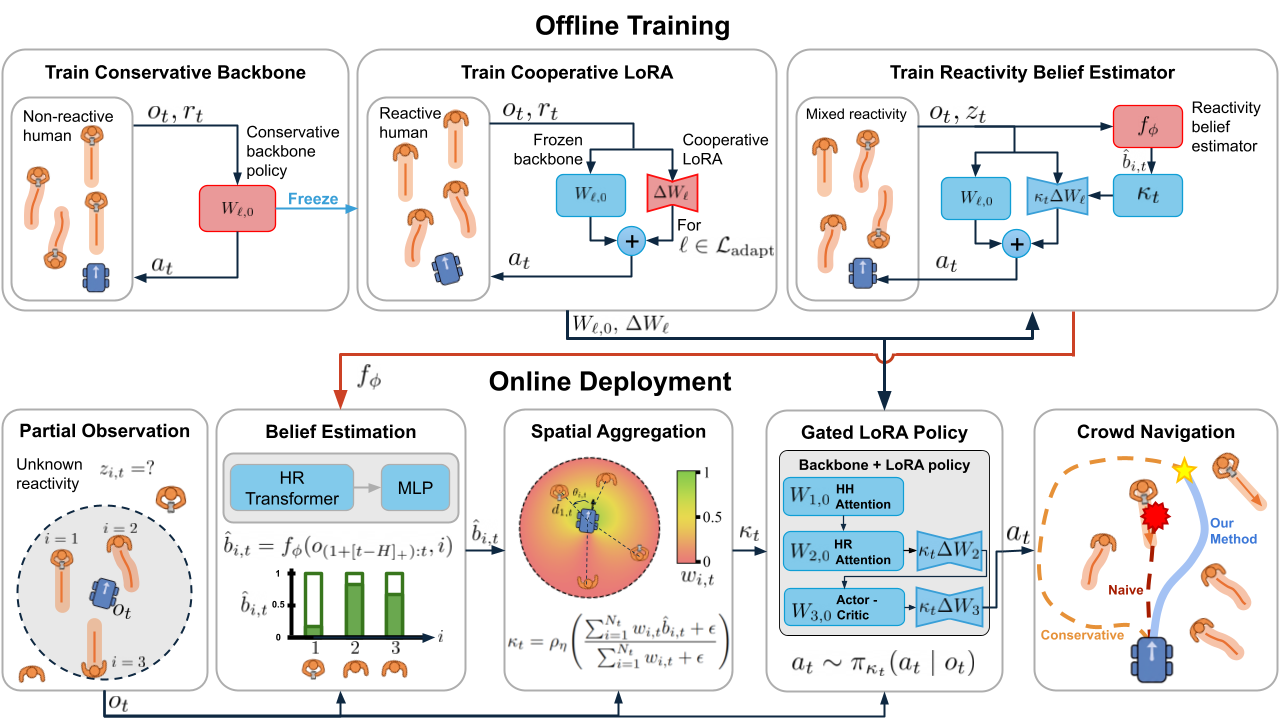
Overview of the RCRA Framework
The upper part of the diagram shows the offline training process. We first train a conservative navigation policy with non-reactive pedestrians and freeze its parameters. Low-rank residual modules are then trained with reactive pedestrians, and a reactivity estimator is trained and refined using observations collected by the adaptive policy.
The lower part shows online deployment. From motion history and robot context, the estimator predicts each pedestrian's reactivity. These estimates are aggregated using distance and bearing, emphasizing nearby pedestrians ahead of the robot. The resulting scale controls the residual strength in the navigation policy, allowing the robot to adjust its behavior as local interactions change without online gradient updates.
Results from Crowd Navigation Simulations
Reactive pedestrians account for the robot in their collision-avoidance decisions, while non-reactive pedestrians respond only to other pedestrians. We evaluate RCRA with 20 pedestrians in a 12 m × 12 m CrowdNav environment. Five scenarios vary pedestrian responses across people, locations, and time: Non-reactive, Reactive, Mixed, Spatial Clusters, and Time-varying.
Reactivity Estimation and Navigation Performance
We compare our learned reactivity estimator with the Bayesian inference component of Behavior-Driven Danger Signaling (BDDS), keeping the navigation backbone, learned residual, and spatial weighting fixed. The table reports both reactivity classification accuracy and downstream navigation performance in Mixed, Spatial Clusters, and Time-varying crowds. Averaged across these three scenarios, learned conditioning improves accuracy and reduces collision rate from 6.56% to 4.85%, while reducing path length by 3.6%. These results show how improved reactivity estimates support navigation under heterogeneous and changing interactions.
Reactivity estimation and downstream navigation with BDDS and our learned estimator.
Scenario
Estimator
Acc. (%) ↑
SR (%) ↑
CR (%) ↓
NT (s) ↓
PL (m) ↓
Mixed
BDDS
72.8
93.60
6.40
14.10
14.07
Learned (Ours)
84.6
96.08
3.92
13.68
13.64
Spatial Clusters
BDDS
72.1
93.28
6.72
13.60
13.56
Learned (Ours)
84.4
94.88
5.12
13.01
12.98
Time-varying
BDDS
70.8
93.44
6.56
14.72
14.66
Learned (Ours)
77.1
94.48
5.52
14.19
14.13
Notes: Navigation components are held fixed, and only the supplied reactivity estimates change. Acc.: classification accuracy; SR: success rate; CR: collision rate; NT: navigation time; PL: path length. Bold and underlined means indicate the best and second-best values within each scenario and metric. NT and PL are computed over successful episodes.
Navigation in Mixed Crowds
This comparison illustrates how different policies handle reactive and non-reactive pedestrians within the same scene. The conservative policy takes a long detour, while the naive policy follows a direct route but collides with a non-reactive pedestrian. RCRA adjusts its residual strength as local interactions change, using opportunities created by reactive pedestrians while becoming more conservative near a non-reactive pedestrian.
Representative mixed-crowd executions from the manuscript illustrate conservative, naive, and reactivity-conditioned navigation.
Performance Across Interaction Scenarios
Across the five scenarios, RCRA reduces average navigation time by 16.8% and path length by 16.7% relative to GenSafeNav (Cons.), while mean success rate decreases from 98.35% to 96.05%. In fully reactive crowds, navigation time and path length decrease by approximately 32%, with a 99.28% success rate. These results demonstrate the empirical trade-off between navigation efficiency and success.
Comparison of GenSafeNav (Cons.), GenSafeNav (Naive), and RCRA across five interaction scenarios.
Scenario
Method
SR (%) ↑
NT (s) ↓
PL (m) ↓
Non-reactive
GenSafeNav (Cons.)
97.20
16.59
16.52
GenSafeNav (Naive)
59.52
11.61
11.58
RCRA (Ours)
95.52
15.86
15.80
Reactive
GenSafeNav (Cons.)
100.00
16.24
16.19
GenSafeNav (Naive)
99.20
10.69
10.66
RCRA (Ours)
99.28
11.02
11.01
Mixed
GenSafeNav (Cons.)
98.56
16.61
16.55
GenSafeNav (Naive)
82.40
11.36
11.34
RCRA (Ours)
96.08
13.68
13.64
Spatial Clusters
GenSafeNav (Cons.)
97.12
15.47
15.40
GenSafeNav (Naive)
82.88
10.83
10.80
RCRA (Ours)
94.88
13.01
12.98
Time-varying
GenSafeNav (Cons.)
98.88
16.50
16.44
GenSafeNav (Naive)
81.84
11.60
11.55
RCRA (Ours)
94.48
14.19
14.13
Notes: Results are reported as means across five random seeds, using 1,250 test episodes per scenario. Bold and underlined means indicate the best and second-best values, respectively, among the displayed methods within each scenario. Navigation time and path length are computed over successful episodes and should be interpreted alongside success rate.
Real-Robot Experiments
We validate residual adaptation on a Clearpath Jackal navigating through four pedestrians: two instructed to maintain their nominal motion and two instructed to respond to the robot. The experiment uses prescribed reactivity labels to isolate the adaptation mechanism.
In the representative comparison, the conservative policy takes a long detour and the naive policy collides with a non-reactive pedestrian. RCRA yields near that pedestrian while using the gap created by reactive pedestrians. Across 30 virtual-pedestrian trials per policy, RCRA achieves 30 successful runs versus 23 for GenSafeNav (Naive), reducing NT by 16.2% and PL by 26.3% relative to GenSafeNav (Cons.). These experiments validate adaptation using prescribed reactivity labels.
Controlled real-robot comparison using prescribed reactivity labels. These trials validate residual modulation on hardware; the learned reactivity estimator is evaluated separately.
Reactivity Estimation from Real Human Motion
We evaluate the estimator on recorded moving-robot trajectories from PeRoI, using avoidance and neutrality annotations as proxies for reactive and non-reactive behavior. The estimator achieves 73.0% balanced accuracy, compared with 68.8% for the tuned Behavior-Driven Danger Signaling (BDDS) baseline. This offline evaluation supports learning reactivity cues from observed human motion. Evaluating the learned estimator in closed-loop real-robot navigation remains future work.